
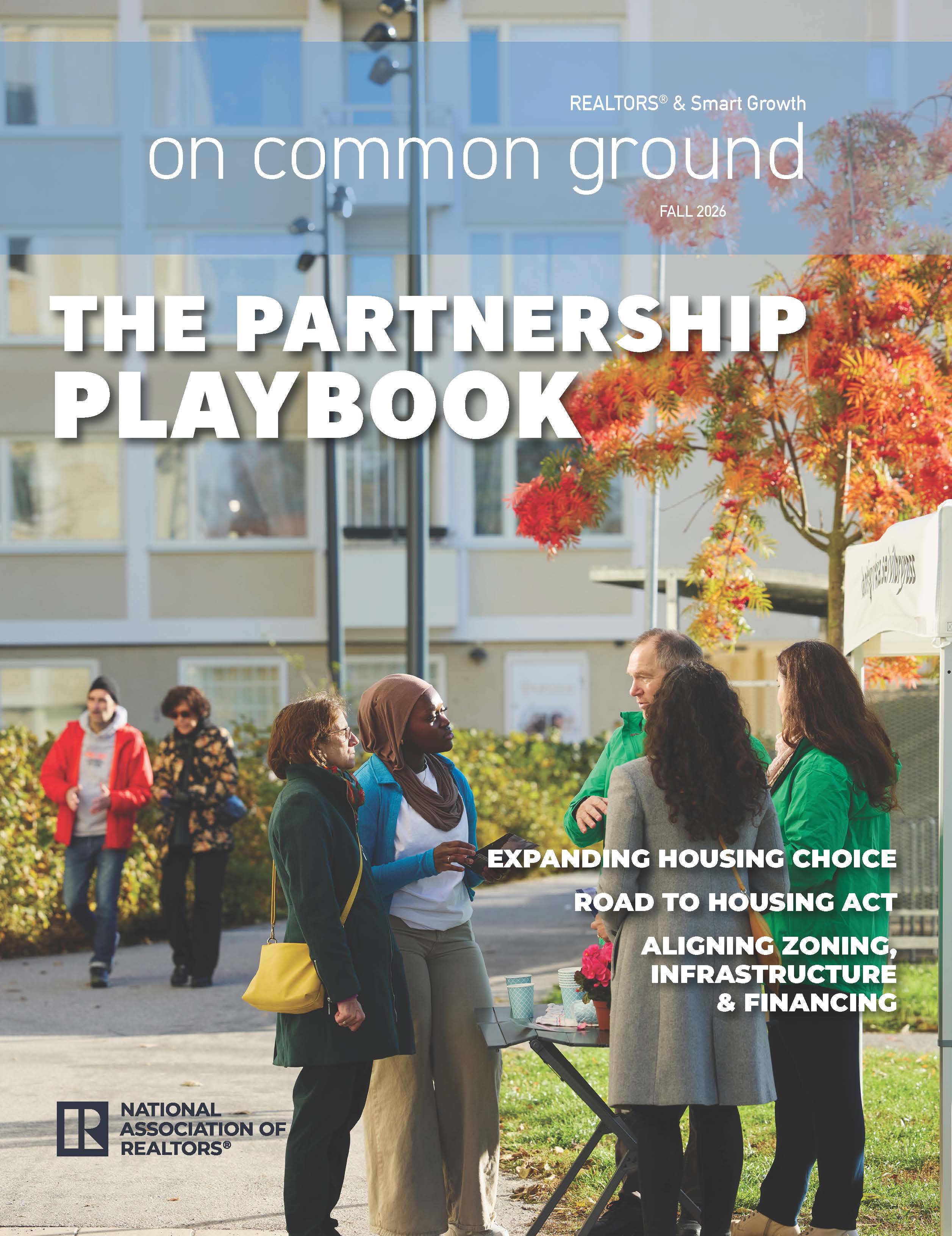
Fall 2026 Partnership Playbook issue of On Common Ground coming 11/4/26
LATEST ISSUE · FALL 2026
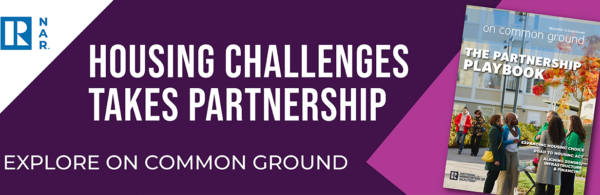
On Common Ground – The Partnership Playbook: Expanding Housing Choice
Discover how collaboration can help communities address housing challenges, from zoning and financing to infrastructure.
This issue will explore how smart growth and partnerships can expand housing choices and improve affordability. Includes stories covering infill housing, missing middle zoning reforms, school district housing partnerships, infrastructure and financing solutions, REALTOR® associations leading local housing efforts and much more. Plus, explore findings from NAR’s 2026 Community & Transportation Preferences Survey.
In This Issue

Addressing Housing Challenges Through Smart Growth
This issue of On Common Ground explores how partnerships are helping communities address housing challenges through smart growth.

Unlocking More Housing Through Partnerships
Housing opportunities are at the top of the list of just about every local, state and national constituency.

What Americans Want: Housing Choice and Walkability
American consumers are blessed with an extraordinary range of choices. Yet when it comes to housing, the choices are often far narrower.

The ROAD to More Housing Starts at Home
The bipartisan 21st Century ROAD to Housing Act has become law as the first comprehensive federal effort to promote housing supply in recent memory.

Zoning Reforms Could Stimulate More Missing Middle Housing
While estimates vary, most experts agree that the United States is facing a severe housing shortage.

Public Buildings and New Opportunities: School Districts as Housing Partners
School districts are converting unused land and buildings into affordable staff housing to improve teacher recruitment and retention.

Supporting Housing Through Infrastructure
Virtually every think tank that has studied housing has concluded that America has not built nearly enough housing over the past several decades.

Financing Homes That the Market Misses
Community programs, credit unions, CDFIs, appraisal reforms, and down payment assistance initiatives can help close homeownership gaps

REALTORS® Take Action: Local REALTOR® Associations as Housing Problem-Solvers
REALTORS® can connect limited housing options with reduced affordability and underscore how local businesses benefit when a community adds homes
Digital Distribution Toolkit





Social Media Captions:
Choose a story that connects to a local housing priority. Add your association’s perspective or a relevant local example, and link directly to the article.
For Elected Officials/Government Staff:
For Community Leaders:
For REALTORS®
Communication Options and Sample Messages:
1) For Elected Officials/Government Staff:
Subject: Housing Solutions to Inform Our Local Work
Hello [Name],
Expanding housing choices in [community] takes coordination across policy, infrastructure and financing. The Fall 2026 issue of On Common Ground, published by the National Association of REALTORS®, explores how communities are bringing these pieces together through local partnerships.
We thought [article title] would be particularly relevant to our ongoing conversations about [local housing priority]. It highlights [specific approach or example], offering ideas to consider as we work toward meeting local housing needs.
[Read the article]
Our association welcomes the opportunity to discuss how these approaches could inform our work together.
2) For Community Leaders:
Subject: Ideas for Addressing Housing Needs Together
Hello [Name],
Housing choices affect whether people can put down roots, work nearby and remain in their communities as their needs change. Addressing those needs takes partners with different perspectives and expertise.
We’re sharing [article title] from the Fall 2026 issue of On Common Ground. The article highlights [brief description of the partnership or approach] and offers ideas that may be relevant to [local housing challenge].[Read the article]
As we consider housing needs in [community], we’d welcome your perspective on where collaboration could make a difference.
3) For REALTORS®:
Subject: Housing Insights for Your Clients and Community
Hello [Name],
The housing options available in our community shape what’s possible for your clients. Understanding the barriers, and how communities are addressing them, can strengthen your client conversations and local advocacy.
The Fall issue of On Common Ground explores housing preferences and partnerships that address zoning, infrastructure and financing challenges. We’re highlighting [article title] because it offers [specific insight or practical takeaway] relevant to the communities you serve.
[Read the article]
Have you encountered similar challenges in your work? Share your perspective with [association contact or email] to help inform our association’s housing conversations.
Using the Digital Distribution Toolkit:
One of the key advantages of digital content is flexibility. You can easily tailor and repurpose OCG articles to fit your audience, platform, and timing. Here are a few examples and suggested frequency:
| Audience | Method of Distribution | Content | Frequency |
|---|---|---|---|
| State & Local elected official | Customized email | Single article | As needed |
| Other community leaders | Mail-merged email | Three articles | Bi-monthly |
| Member newsletter | Current platform | Single article | Each edition |
| Member content | Preferred social media | Single article | Monthly |
| Members: Gov Aff Committee | Current platform | Single article | As needed |
Core Standards Credit:
You can earn Core Standards credit by documenting your distribution of OCG. Be sure to record the date sent, the audience, the platform used, and the specific content shared.
Acceptable documentation includes:
- Screenshots of social media posts
- Copies of emails sent (Pro Tip: BCC yourself and save the email in a dedicated Core Standards folder for easy tracking)
This simple documentation ensures your efforts count toward compliance and helps showcase your association’s community engagement.
Questions? Contact Alex Haddad, Manager, Community Development, 202-383-1129