
The National Association of REALTORS®’ Community and Transportation Preference Survey is a nationally representative survey conducted every three years to better understand how Americans want to live, work, and move through their communities. The survey explores consumer preferences related to housing, transportation, community design, and smart growth, providing valuable insights into the features and amenities people value most from walkable neighborhoods and housing choice to convenient access to jobs, schools, parks, shopping, and transportation options. The findings help REALTORS®, REALTOR associations, local leaders, planners, and policymakers make data-informed decisions that support vibrant, resilient communities and address evolving housing and community development needs.
Questions? Contact Alex Haddad, Manager, Community Development, 202 383 1129.
2026 Community and Transportation Preference Survey
A national poll conducted in May 2026 of 2,000 adults in the fifty-largest metro areas found that Americans continue to place a high value on walkable, mixed-use communities and access to a variety of housing choices. The survey found that sidewalks, parks, shops, restaurants, and other nearby destinations remain important considerations when deciding where to live. Nearly two-thirds of respondents indicated they would be willing to pay more to live in a walkable community, and a majority preferred a smaller lot in a walkable neighborhood over a larger homesite requiring more driving. The survey also found broad support for community design that reduces dependence on long driving trips and expands housing options, including small-lot single-family homes, townhomes, and duplexes.
State and Local REALTOR® Associations: Access the customizable press release to communicate details to members and/or to help advocate for a range of housing types, open space and walkable neighborhoods.
- Press Release
- Customizable press release (customizable for use by state and local associations – Word Document)
- Top Line Results
- Infographic
- Analysis and Slides
- Social Media Toolkit
2023 Community and Transportation Preference Survey
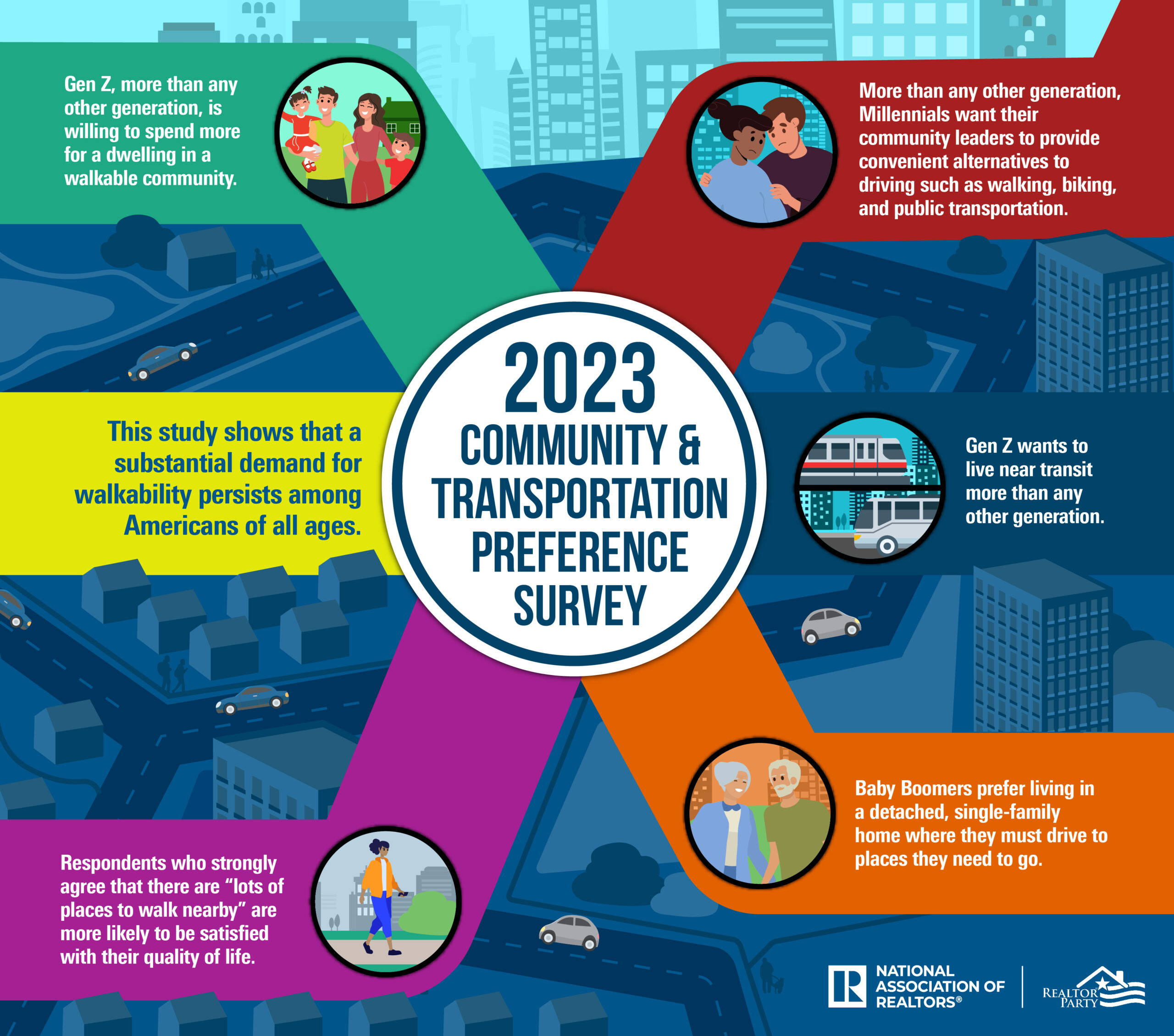
A national poll conducted in April of 2,000 adults in the fifty-largest metro areas found that coming out of the Coronavirus pandemic that demand for living in a walkable community remains robust. The survey shows that people living in walkable communities more likely to be very satisfied with their quality of life; that over 30% of Gen Z and Millennial respondents willing to “pay a lot more” to live in a walkable community and 53% of all respondents indicting that they would prefer to live in an attached dwelling (apartment, condo, townhome) rather than a detached single-family home if it meant they would have an easy walk to shops and restaurants.
State and Local REALTOR® Associations: Access the customizable press release to communicate details to members and/or to help advocate for a range of housing types, open space and walkable neighborhoods.
- Press Release
- Customizable press release (customizable for use by state and local associations – Word Document)
- Topline results
- Infographic
- Analysis and Slides
2020 Community and Transportation Preference Survey
A national poll conducted in July of 2,000 adults in the 50 largest metro areas found that the Coronavirus pandemic has caused some shifts in where families with children would like to live. Specifically there was an increased preference to a location where families could have a detached home with a large yard. In contrast, interest in walkable communities is strong. Twenty percent of respondents who were living in a detached home currently would prefer to live in an attached home in a walkable community with shorter commute. This compares to 10 percent of respondents that would prefer to move from an attached home in a walkable community to a detached dwelling. Finally, people with place to walk in their community continue to be the most satisfied with their quality of life. For more findings and insight from the 2020 Community and Transportation preference survey, see the full survey results below.
State and Local REALTOR® Associations: Access the customizable press release to communicate details to members and/or to help advocate for a range of housing types, open space and walkable neighborhoods.
- Press release
- Customizable press release (customizable for use by state and local associations – Word Document)
- Topline results
- Infographic
- Analysis and slides
2017 Community and Transportation Preference Survey
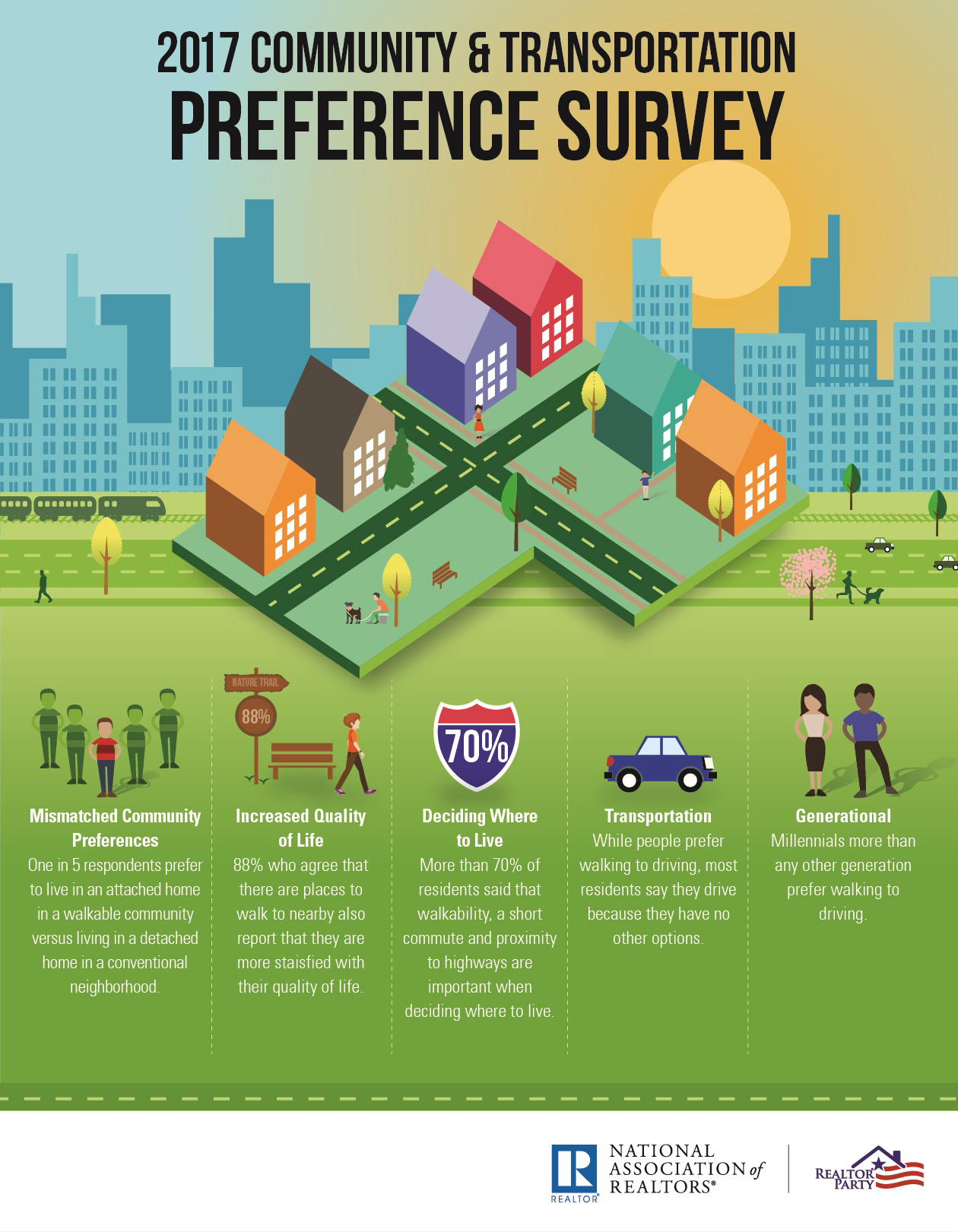
A national poll of 3,000 adults in the fifty largest metro areas found that it is no longer just Millennials propelling interest in walkable communities. This new report shows that the Silent and Greatest Generation prefer smaller homes in neighborhoods with easy walks to shops and restaurants. The poll was conducted by the National Association of REALTORS®.
[/vc_column_text][/vc_column][/vc_row]